
Introduction
Fellow indoor positioning project practitioners often stumble into the same pitfall—Insufficient UWB base stations.Initial scan revealed critical issues: poor accuracy, blind spots, and complete coverage gaps behind columns. Re-scanning? Budget already exceeded, cabling needs rerouting, project timeline delayed—deadlock achieved.
The issue lies in an old saying:The number of base stations isn't arbitrary; it's calculated using a three-dimensional model based on accuracy, coverage area, and signal obstruction.Miscalculation means you're the one who loses. Today, here's a ready-to-use algorithm for you.
First, clarify your positioning dimensions: how many do you actually need?
Before calculating base stations, the first thing to clarify is—How many dimensions of positioning are required?This is the first metric to determine how many to install.
· Zero-dimensional (Presence Sensing)You only need to know if anyone is in the workshop. A simple entry/exit check is sufficient; precise tracking isn't required.
· 1D (corridor/tunnel): It only matters where a person is located along that line. For example, for a long corridor several meters wide, just deploy stations along its length.
· 2D (Planar Positioning)To achieve true positioning—knowing exactly where a person is at coordinates (x,y) within the workshop—the base stations must be deployed across the entire area.
The key point lies in this sentence:Beyond 2D, 0D and 1D solutions also significantly reduce the number of base stations required and cut costs substantially.Many projects fail because of poor planning—what could have been a zero-dimensional solution ended up as an expensive two-dimensional one.
Bottom line: One table to see how many you need.
If you confirm that this is the most common option2D Positioning, roughly as follows:
Scenario | Reference Base Station Count |
Small Room / Single Channel (Dozens of Square Meters) | 3–4 |
Medium Workshop / Warehouse (Several Hundred Square Meters) | 5–8 |
Large Industrial Facilities / Parking Lots (1,000+ sqm) | Place points on a 5–15 meter grid to check accuracy. |
Note: This is a reference range only. See the algorithm below for exact values.
Three Key Parameters for Quantity Calculation
The actual count is determined by these three parameters:
1. Required positioning accuracy
Do you need 0.1 meters or 0.5 meters? The site spacing is completely different. Higher precision requirements mean more base stations and a denser network.
2. Base station coverage area
In open line-of-sight conditions, a standard UWB base station can cover tens of meters. However, indoors, walls, shelving units, and equipment significantly reduce this range, leaving many areas uncovered by a single station.
3. Location Method
Whether to use ToF (Time of Flight) or TDoA (Time Difference of Arrival) affects the deployment logic, as well as the required number and placement of base stations.
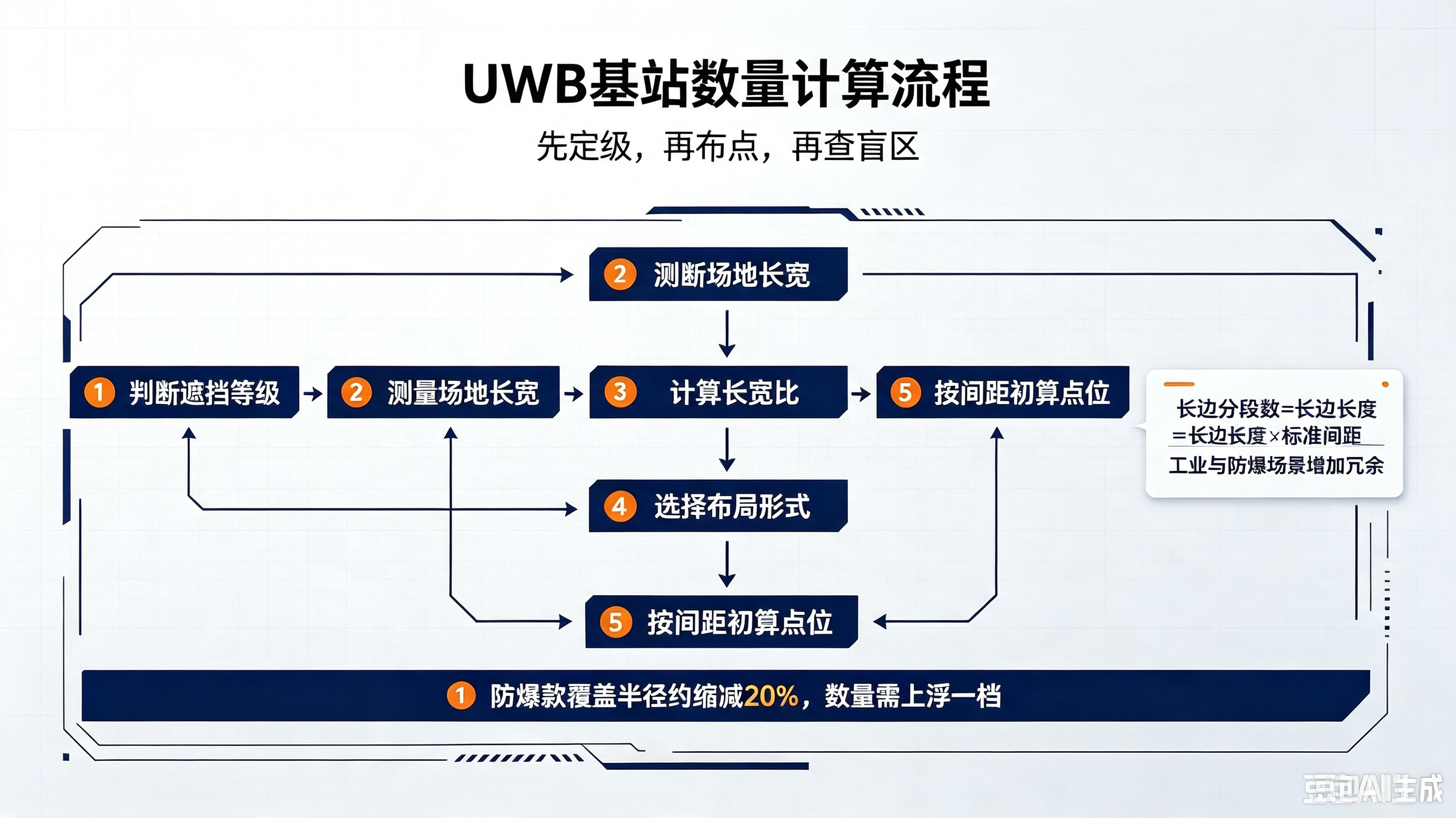
A ready-to-use estimation formula
· Area MethodTotal site area ÷ Effective coverage per base station ≈ Number of base stations
· Spacing Method: Reverse-engineer base station spacing based on accuracy requirements (in high-precision scenarios, spacing is often reduced to 5–8 meters).
· Keep redundantCover boundaries, beams, columns, and blind spots. Typically, leave a 10%–20% buffer.
Combine all three methods to ensure accurate results.
UWB isn't the right fit for every scenario.
One thing you should especially keep in mind:UWB isn't a one-size-fits-all solution, nor is it always the most cost-effective.
· Scenarios for Savings · Bluetooth FallbackIf you only need to detect "presence in the room" (zero-dimensional detection), Bluetooth positioning is sufficient. Skip the expensive UWB base station procurement and installation costs. Don't use a cannon to shoot a mosquito.
· Rugged Scenarios: Harsh Outdoor EnvironmentsIf the environment has significant obstructions and many reflective surfaces, but high positioning accuracy is required and the budget allows, UWB base stations can still deliver.
Clarify the conclusion first:Decide between UWB and Bluetooth based on the required dimensions and accuracy.Get the direction right, and every dollar counts.
Three Pitfalls to Avoid
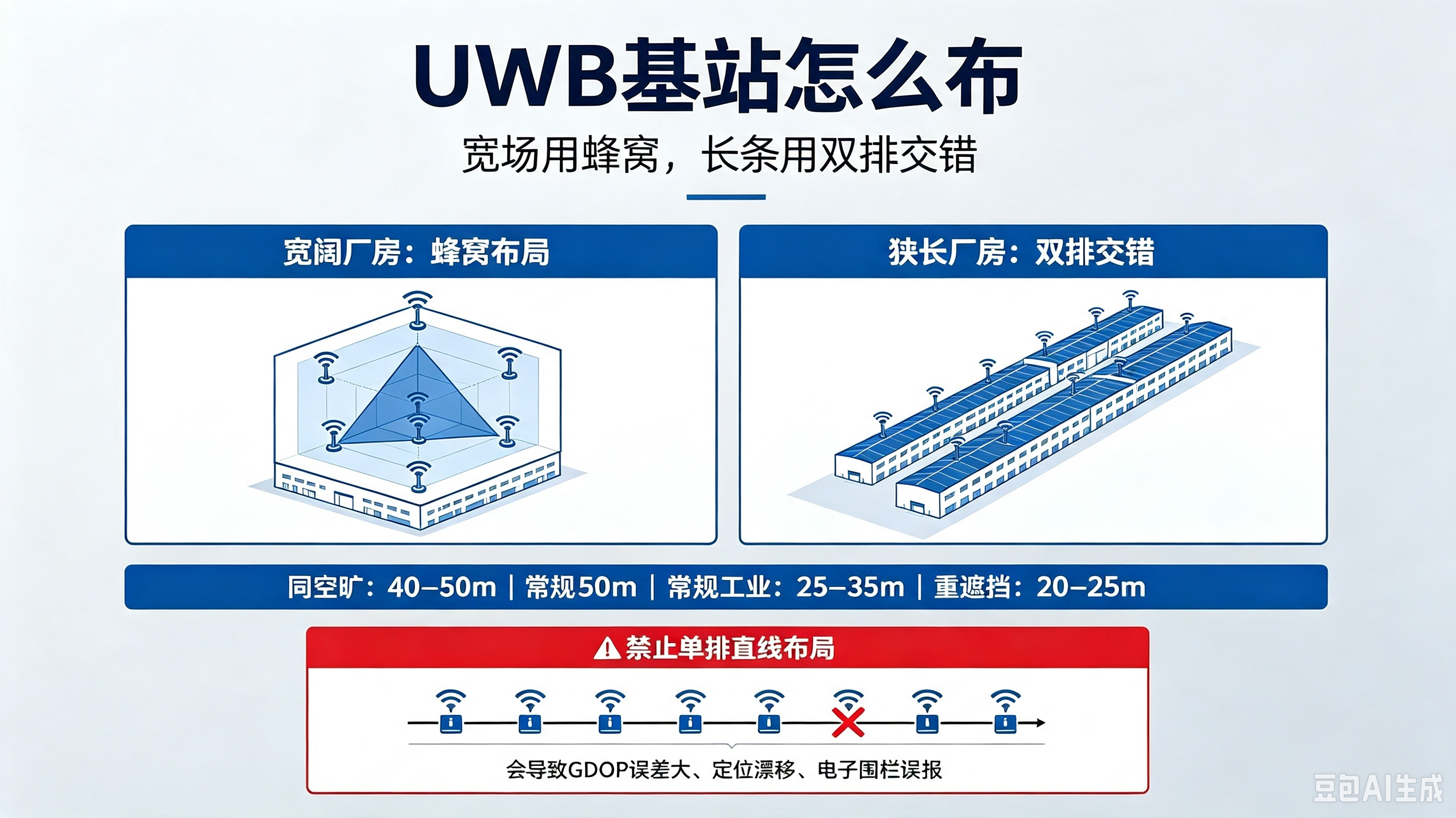
1. Don't just count the numbers; focus on coverage.For 2D positioning, ensure that any location is covered by at least 3 base stations simultaneously (based on the three-point trilateration principle). Having enough base stations does not guarantee accurate positioning.
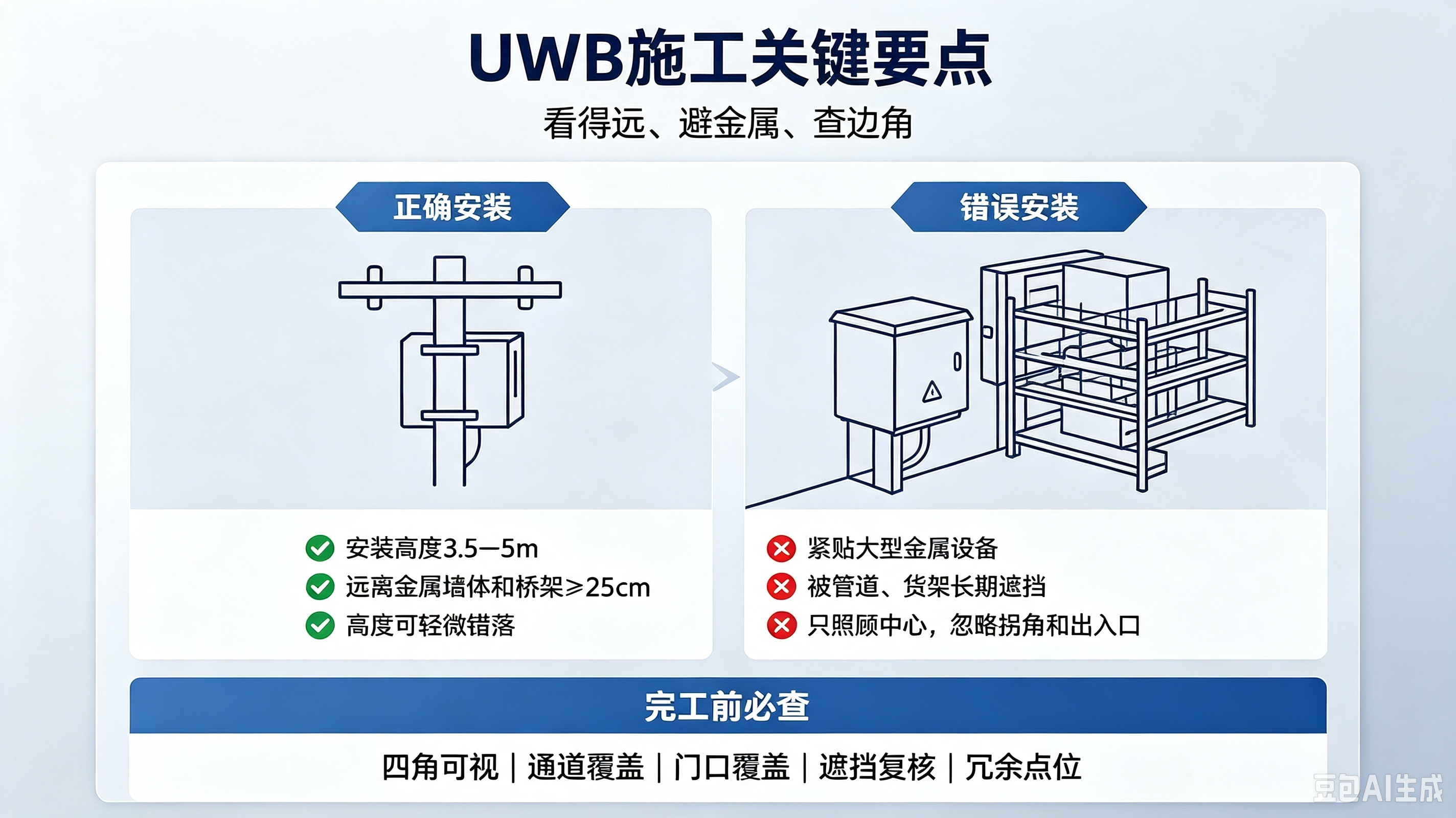
2. Indoor obstructions are the biggest variable.Steel structures, shelving units, and load-bearing columns significantly block UWB signals, causing a large discrepancy between theoretical calculations and actual on-site measurements.
3. Hate starting work on a rough guess.It's better to finalize the algorithms, drawings, and point locations upfront than to rework after issues arise on-site.
Final thoughts: Let professionals handle your calculations.
Go back to the first sentence:Define dimensions first, calculate precision next, then check for occlusions.That's how we calculate the number of UWB base stations. When you get the direction right, your investment pays off.
For indoor positioning projects, skip the guesswork: deploy on-sitePlease send the floor plan.Komi calculates your base station count and deployment plan upfront, delivering both the solution and hardware in one go. Start your project without worrying about under-provisioning.
Kemei InnovationOver a decade of expertise in high-precision positioning through Beidou + UWB fusion, specializing inBeidou RTK High-Precision + UWB Indoor-Outdoor Integrated PositioningWe are a true ground-up positioning hardware manufacturer with end-to-end hardware capabilities, proprietary hardware and embedded software, in-house production lines for controlled quality and delivery, and integrated solution + hardware offerings. For indoor positioning, we deliver everything from station calculation solutions to positioning hardware—all in one place.
Summary: FAQ:
Q: How many UWB anchors are needed for indoor positioning?
Not a guess—it's calculated using the 3D model of "precision + area + occlusion." Reference: Small rooms/single channel 3-4 units; Medium workshops/warehouses 5-8 units; Large factories use a grid spacing of 5-15 meters.
Q: What parameters determine the number of UWB base stations?
A: Required positioning accuracy, base station coverage (attenuated by indoor obstructions), and positioning method (ToF vs. TDoA).
Q: When to use UWB vs. Bluetooth?
Use Bluetooth for simple "room occupancy" detection (0D presence sensing) to avoid costly UWB base stations. Choose UWB when you have high occlusion, many reflective surfaces, require high precision, and have the budget.
Q: How many anchor points are required for UWB 2D positioning?A: Any location must be covered by at least 3 base stations simultaneously (trilateration principle). Having enough signals doesn't guarantee a fix.